Steel vs. concrete
As raw material prices fluctuate, often so does building design. During times of lower steel prices, more steel and less concrete is used, and vice versa. Each set of vendors and users typically maintain national industry associations that advocate the use of its materials versus the other. However, both materials are typically used together. Concrete without steel reinforcement (usually ribbed round bars called rebar) crumbles under tensile loads. Steel on its own, without composite or reinforced concrete floors, is likewise not a preferred building method.
While rebar is almost always steel, it is not considered a structural steel and is described separately in the rebar and reinforced concrete articles. While both steel structures and Reinforced concrete cement(R.C.C)structures have their pros and cons,the steel structures have better strength to weight ratio than RCC, and can be easily dismantled(Steel structures,which have bolted connections can also be reused to some extent after dismantling).
[edit]Thermal properties
The properties of steel vary widely, depending on its alloying elements.
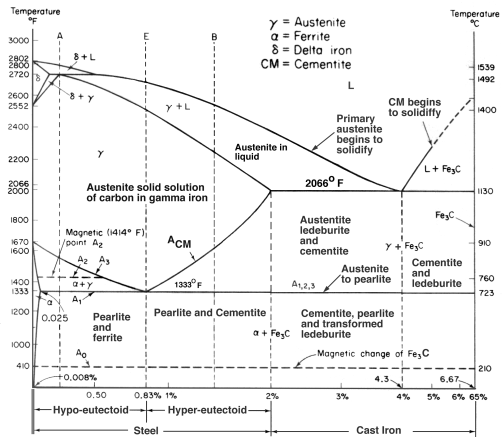
The austenizing temperature, the temperature where a steel transforms to an austenite crystal structure, for steel starts at 900°C for pure iron, then, as more carbon is added, the temperature falls to a minimum 724°C for eutectic steel (steel with only .83% by weight of carbon in it). As 2.1% carbon (by mass) is approached, the austenizing temperature climbs back up, to 1130°C. Similarly, the melting point of steel changes based on the alloy.
The lowest temperature at which a plain carbon steel can begin to melt, its solidus, is 1130 °C. Steel never turns into a liquid below this temperature. Pure Iron ('Steel' with 0% Carbon) starts to melt at 1492 °C (2720 °F), and is completely liquid upon reaching 1539 °C (2802 °F). Steel with 2.1% Carbon by weight begins melting at 1130 °C (2066 °F), and is completely molten upon reaching 1315 °C (2400 °F). 'Steel' with more than 2.1% Carbon is no longer Steel, but is known as Cast iron. http://www.msm.cam.ac.uk/phase-trans/images/FeC.gif
[edit]Fireproofing of structural steel
In order for a fireproofing product to qualify for a certification listing of structural steel, through a fire test, the critical temperature is set by the national standard, which governs the test. In Japan, this is below 400°C. In China, Europe and North America, it is set at 540°C. The time it takes for the steel element that is being tested to reach the temperature set by the national standard determines the duration of the fire-resistance rating.
Care must be taken to ensure that thermal expansion of structural elements does not damage fire-resistance rated wall and floor assemblies. Penetrants in a firewalls and ferrous cable trays in organicfirestops should be installed in accordance with an appropriate certification listing that complies with the local building code.
Open Web Steel Joists (OWSJ) require a great deal of spray fireproofing because they are not very massive and also because they are so open, that a lot of the sprayed plaster flies right past its constituent parts during the coating process.
Structural steel requires external insulation (fireproofing) in order to prevent the steel from weakening in the event of a fire. When heated, steel expands and softens, eventually losing its structural integrity. Given enough energy, it can also melt. Heat transfer to the steel can be slowed by the use of fireproofing materials. While concrete structures that comprise buildings are able to achieve fire-resistance ratings without additional fireproofing, concrete can be subject to severe spalling, particularly if it has an elevated moisture content. Fireproofing is available for concrete but this is typically not used in buildings. Instead, it is used in traffic tunnels and locations where a hydrocarbon fire is likely to break out. Thus, steel and concrete compete against one another not only on the basis of the price per unit of mass but also on the basis of the pricing for the fireproofing that must be added in order to satisfy the passive fire protection requirements that are mandated through building codes. Common fireproofing methods for structural steel include intumescent, endothermic and plaster coatings as well as drywall, calcium silicate cladding, and mineral or high temperature insulation wool in the form of blanket.

No comments:
Post a Comment