Wednesday, 1 April 2015

Think Green - Think Steel Structures

Steel buildings have become increasingly popular these days because they are greener options. Steel are sturdier and stronger and help in maintaining ecological balance of the earth. Felling of trees has reduced to a considerable extent because of steel constructions. Entrepreneurs are recently considering steel buildings over traditional brick and mortar establishments because they last longer than the latter. They offer multiple advantages to the owner of establishment.
The main reason why steel are preferred over others is because they are energy-efficient and are less prone to climatic adversities. They are cost-effective and can be easily installed. Builders are opting for green constructions because they have zero effects on the environment. These buildings are developed faster than the traditional ones. The steel structures are heavy and don't catch fire easily; in fact one can say that steel buildings are fire resistant. Experts say that steel is 65% reusable. Earthquakes, tornados, hailstorms, hurricanes and heavy snowfall have the least effect on steel because of their sturdy nature.
Moreover, maintenance costs for steel are almost zero. Steel constructions are advantageous for agricultural interests. Plants and herbs thrive best inside a steel construction because the later is less prone to destruction caused by insects. Unlike wooden establishments, those constructed with steel repel insects. Your needs define the different types of steel structures available in the industry. However, it is important that you ascertain your requirements before selecting one.
The different types of steel structures are discussed in the following lines:
Modular Frame: These frames make use of columns for interiors. The weight of the steel structure is equally spread causing less overall pressure. Building foundation costs are decreased. Modular frames are best suited for construction of factories.
Single Slope Frame: This steel comes in different heights. The slope of the roof is structured backwards. Designing such frames require you to ascertain the frame's lower part and also the pitch of the roof. Shopping arcades, storage areas and office space are best suited for single slope frame.
Clan Span Frame: They are the most economical, versatile and sturdier options in use. Such steel structures don't usually need help of interior columns to support them. Clan span frame is best suited to construct warehouses, factories and storage areas.
Steel structures come in different shapes and sizes. They have a wide range of benefits to offer the owner of the establishments. So, if you are thinking about going green then, steel are best for use.
Henrich Greve is a content writer on steel structures. For more information he always recommends you to visit http://www.steelbuildings.co.uk/.


Article Source: http://EzineArticles.com/6943677

Sunday, 28 November 2010

Purlin Size

function: c shape purlin, z shape purlin, h shape beam are widely used in factory buildings, high buildings, large-span bridges, gymnasiums, and portable houses. size of c shape purlins: 1) no. 1 model: a) size: 80 x 40 x 15 b) thickness: 2.0 - 3.0mm c) coil width: 166mm 2) no. 2 model: a) size: 80 x 40 x 20 b) thickness: 2.0 - 3.0mm c) coil width: 176mm 3) no. 3 model: a) size: 100 x 50 x 20 b) thickness: 2.0 - 3.0mm c) coil width: 216mm 4) no. 4 model: a) size: 100 x 60 x 20 b) thickness: 2.0 - 3.0mm c) coil width: 236mm 5) no. 5 model: a) size: 120 x 50 x 20 b) thickness: 2.0 - 3.0mm c) coil width: 236mm 6) no. 6 model: a) size: 120 x 60 x 20 b) thickness: 2.0 - 3.0mm c) coil width: 256mm 7) no. 7 model: a) size: 140 x 50 x 20 b) thickness: 2.0 - 3.0mm c) coil width: 256mm 8) no. 8 model: a) size: 140 x 60 x 20 b) thickness: 2.0 - 3.0mm c) coil width: 276mm 9) no. 9 model: a) size: 160 x 60 x 20 b) thickness: 2.0 - 3.0mm c) coil width: 296mm 10) no. 10 model: a) size: 160 x 70 x 20 b) thickness: 2.0 - 3.0mm c) coil width: 316mm 11) no.11 model: a) size: 180 x 60 x 20 b) thickness: 2.0 - 3.0mm c) coil width: 316mm 12) no. 12 model: a) size: 180 x 70 x 20 b) thickness: 2.0 - 3.0mm c) coil width: 336mm 13) no. 13 model: a) size: 200 x 60 x 20 b) thickness: 2.0 - 3.0mm c) coil width: 336mm 14) no. 14 model: a) size: 200 x 70 x 20 b) thickness: 2.0 - 3.0mm c) coil width: 356mm 15) no. 15 model: a) size: 220 x 60 x 20 b) thickness: 2.0 - 3.0mm c) coil width: 356mm 16) no. 16 model: a) size: 220 x 70 x 20 b) thickness: 2.0 - 3.0mm c) coil width: 376mm 17) no. 17 model: a) size: 240 x 60 x 20 b) thickness: 2.0 - 3.0mm c) coil width: 376mm 18) no. 18 model: a) size: 240 x 70 x 20 b) thickness: 2.0 - 3.0mm c) coil width: 396mm size of z shape purlins: 1) no. 1 model: a) size: 80 x 40 x 20 b) thickness: 2.0 - 3.0mm c) coil width: 179mm 2) no. 2 model: a) size: 100 x 40 x 20 b) thickness: 2.0 - 3.0mm c) coil width: 199mm 3) no. 3 model: a) size: 100 x 50 x 20 b) thickness: 2.0 - 3.0mm c) coil width: 219mm 4) no. 4 model: a) size: 120 x 40 x 20 b) thickness: 2.0 - 3.0mm c) coil width: 219mm 5) no. 5 model: a) size: 120 x 50 x 20 b) thickness: 2.0 - 3.0mm c) coil width: 239mm 6) no. 6 model: a) size: 140 x 50 x 20 b) thickness: 2.0 - 3.0mm c) coil width: 259mm 7) no. 7 model: a) size: 140 x 60 x 20 b) thickness: 2.0 - 3.0mm c) coil width: 279mm 8) no. 8 model: a) size: 160 x 50 x 20 b) thickness: 2.0 - 3.0mm c) coil width: 279mm 9) no. 9 model: a) size: 160 x 60 x 20 b) thickness: 2.0 - 3.0mm c) coil width: 299mm 10) no. 10 model: a) size: 180 x 60 x 20 b) thickness: 2.0 - 3.0mm c) coil width: 319mm 11) no. 11 model: a) size: 180 x 70 x 20 b) thickness: 2.0 - 3.0mm c) coil width: 339mm 12) no. 12 model: a) size: 200 x 60 x 20 b) thickness: 2.0 - 3.0mm c) coil width: 339mm 13) no. 13 model: a) size: 200 x 70 x 20 b) thickness: 2.0 - 3.0mm c) coil width: 359mm 14) no. 14 model: a) size: 220 x 60 x 20 b) thickness: 2.0 - 3.0mm c) coil width: 359mm 15) no. 15 model: a) size: 220 x 70 x 20 b) thickness: 2.0 - 3.0mm c) coil width: 379mm 16) no. 16 model: a) size: 240 x 60 x 20 b) thickness: 2.0 - 3.0mm c) coil width: 379mm 17) no. 17 model: a) size: 240 x 70 x 20 b) thickness: 2.0 - 3.0mm c) coil width: 399mm 18) no. 18 model: a) size: 250 x 60 x 20 b) thickness: 2.0 - 3.0mm c) coil width: 389mm

Structural Engineering


Structural engineering is a field of engineering dealing with the analysis and design of structures that support or resist loads. Structural engineering is usually considered a specialty within civil engineering, but it can also be studied in its own right.[1] Structural engineers are most commonly involved in the design of buildings and large nonbuilding structures[2] but they can also be involved in the design of machinerymedical equipmentvehicles or any item where structural integrity affects the item's function or safety. Structural engineers must ensure their designs satisfy given design criteria, predicated on safety (e.g. structures must not collapse without due warning) or serviceability and performance (e.g. building sway must not cause discomfort to the occupants). Buildings are made to endure massive loads as well as changing climate and natural disasters.
Structural engineering theory is based upon physical laws and empirical knowledge of the structural performance of different landscapes and materials. Structural engineering design utilises a relatively small number of basic structural elements to build up structural systems that can be very complex. Structural engineers are responsible for making creative and efficient use of funds, structural elements and materials to achieve these goals.[2]

Steel Speciality


Steel vs. concrete

As raw material prices fluctuate, often so does building design. During times of lower steel prices, more steel and less concrete is used, and vice versa. Each set of vendors and users typically maintain national industry associations that advocate the use of its materials versus the other. However, both materials are typically used together. Concrete without steel reinforcement (usually ribbed round bars called rebar) crumbles under tensile loads. Steel on its own, without composite or reinforced concrete floors, is likewise not a preferred building method.
While rebar is almost always steel, it is not considered a structural steel and is described separately in the rebar and reinforced concrete articles. While both steel structures and Reinforced concrete cement(R.C.C)structures have their pros and cons,the steel structures have better strength to weight ratio than RCC, and can be easily dismantled(Steel structures,which have bolted connections can also be reused to some extent after dismantling).

[edit]Thermal properties

The properties of steel vary widely, depending on its alloying elements.
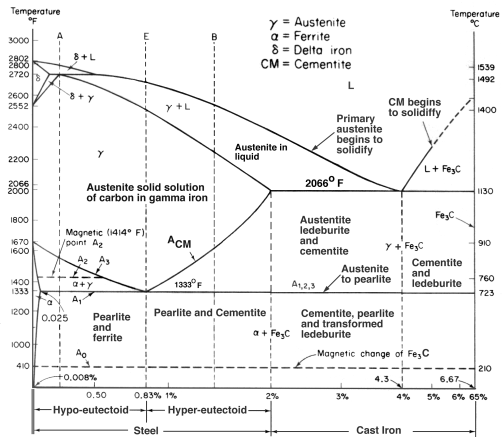
The austenizing temperature, the temperature where a steel transforms to an austenite crystal structure, for steel starts at 900°C for pure iron, then, as more carbon is added, the temperature falls to a minimum 724°C for eutectic steel (steel with only .83% by weight of carbon in it). As 2.1% carbon (by mass) is approached, the austenizing temperature climbs back up, to 1130°C. Similarly, the melting point of steel changes based on the alloy.
The lowest temperature at which a plain carbon steel can begin to melt, its solidus, is 1130 °C. Steel never turns into a liquid below this temperature. Pure Iron ('Steel' with 0% Carbon) starts to melt at 1492 °C (2720 °F), and is completely liquid upon reaching 1539 °C (2802 °F). Steel with 2.1% Carbon by weight begins melting at 1130 °C (2066 °F), and is completely molten upon reaching 1315 °C (2400 °F). 'Steel' with more than 2.1% Carbon is no longer Steel, but is known as Cast ironhttp://www.msm.cam.ac.uk/phase-trans/images/FeC.gif

[edit]Fireproofing of structural steel

In order for a fireproofing product to qualify for a certification listing of structural steel, through a fire test, the critical temperature is set by the national standard, which governs the test. In Japan, this is below 400°C. In ChinaEurope and North America, it is set at 540°C. The time it takes for the steel element that is being tested to reach the temperature set by the national standard determines the duration of the fire-resistance rating.
Care must be taken to ensure that thermal expansion of structural elements does not damage fire-resistance rated wall and floor assemblies. Penetrants in a firewalls and ferrous cable trays in organicfirestops should be installed in accordance with an appropriate certification listing that complies with the local building code.
Open Web Steel Joists (OWSJ) require a great deal of spray fireproofing because they are not very massive and also because they are so open, that a lot of the sprayed plaster flies right past its constituent parts during the coating process.
Structural steel requires external insulation (fireproofing) in order to prevent the steel from weakening in the event of a fire. When heated, steel expands and softens, eventually losing its structural integrity. Given enough energy, it can also melt. Heat transfer to the steel can be slowed by the use of fireproofing materials. While concrete structures that comprise buildings are able to achieve fire-resistance ratings without additional fireproofing, concrete can be subject to severe spalling, particularly if it has an elevated moisture content. Fireproofing is available for concrete but this is typically not used in buildings. Instead, it is used in traffic tunnels and locations where a hydrocarbon fire is likely to break out. Thus, steel and concrete compete against one another not only on the basis of the price per unit of mass but also on the basis of the pricing for the fireproofing that must be added in order to satisfy the passive fire protection requirements that are mandated through building codes. Common fireproofing methods for structural steel include intumescentendothermic and plaster coatings as well as drywallcalcium silicate cladding, and mineral or high temperature insulation wool in the form of blanket.

Standard Structural Steel


Standard structural steels (Europe)

Most steels used throughout Europe are specified to comply with the European standard EN 10025. However, many national standards also remain in force.
Typical grades are described as 'S275J2' or 'S355K2W'. In these examples, 'S' denotes structural rather than engineering steel; 275 or 355 denotes the yield strength in newtons per square millimetre or the equivalent megapascals; J2 or K2 denotes the materials toughness by reference to Charpy impact testvalues; and the 'W' denotes weathering steel. Further letters can be used to designate normalized steel ('N' or 'NL'); quenched and tempered steel ('Q' or 'QL'); and thermomechanically rolled steel ('M' or 'ML').
The normal yield strength grades available are 195, 235, 275, 355, 420, and 460, although some grades are more commonly used than others e.g. in the UK, almost all structural steel is grades S275 and S355. Higher grades are available in quenched and tempered material (500, 550, 620, 690, 890 and 960 - although grades above 690 receive little if any use in construction at present).

[edit]Standard structural steels (USA)

Steels used for building construction in the US use standard alloys identified and specified by ASTM International. These steels have an alloy identification beginning with A and then two, three, or four numbers. The four-number AISI steel grades commonly used for mechanical engineering, machines, and vehicles are a completely different specification series.
The standard commonly used structural steels are:[1]

[edit]Carbon steels

  • A36 - structural shapes and plate
  • A53 - structural pipe and tubing
  • A500 - structural pipe and tubing
  • A501 - structural pipe and tubing
  • A529 - structural shapes and plate

[edit]High strength low alloy steels

  • A441 - structural shapes and plates
  • A572 - structural shapes and plates
  • A618 - structural pipe and tubing
  • A992 - W shapes beams only
  • A270 - structural shapes and plates

[edit]Corrosion resistant high strength low alloy steels

  • A242 - structural shapes and plates
  • A588 - structural shapes and plates

[edit]Quenched and tempered alloy steels

  • A514 - structural shapes and plates
  • A517 - boilers and pressure vessels

Common structural Shape


In most developed countries, the shapes available are set out in published standards, although a number of specialist and proprietary cross sections are also available.
  • I-beam (I-shaped cross-section - in Britain these include Universal Beams (UB) and Universal Columns (UC); in Europe it includes the IPE, HE, HL, HD and other sections; in the US it includes Wide Flange (WF) and H sections)
  • Z-Shape (half a flange in opposite directions)
  • HSS-Shape (Hollow structural section also known as SHS (structural hollow section) and including squarerectangularcircular (pipe) and elliptical cross sections)
  • Angle (L-shaped cross-section)
  • Channel ( [-shaped cross-section)
  • Tee (T-shaped cross-section)
  • Rail profile (asymmetrical I-beam)
  • Bar, a piece of metal, rectangular cross sectioned (flat) and long, but not so wide so as to be called a sheet.
  • Rod, a round or square and long piece of metal or wood, see also rebar and dowel.
  • Plate, metal sheets thicker than 6 mm or 14 in.
  • Open web steel joist
While many sections are made by hot or cold rolling, others are made by welding together flat or bent plates (for example, the largest circular hollow sections are made from flat plate bent into a circle and seam-welded).
Taken from wikipedia


Sunday, 6 September 2009

Structural Steel Detailing - Its Standards and Its Software Tools

Structural steel detailing is the design and drafting of the connections between the steel beams and columns in the massive steel frameworks that form the skeleton of most multi-story buildings in the western hemisphere.

The design of these connections is naturally very critical, since the decoupling of any beams from columns could result in collapse of the steel framework as well as the building, and the consequent deaths of thousands of people.

For that reason there are very exacting standards which are followed for structural steel detailing. These standards are different for every country, and are compiled by recognized industry associations of the concerned country.

Examples of such associations are:

American Institute of Steel Construction (AISC)
Canadian Institute of " " (CISC)
SBI Swedish Institute of " "
EUROFER, the European Confederation of Iron and Steel Industries
African Iron & Steel Association
Arab Iron & Steel Union [AISU]
World Steel Association (formerly IISI)
Brazilian Steel Institute (IBS)
British Constructional Steelwork Association (BCSA)
Iron & Steel Institute of Japan
Korean Iron & Steel Association
Malaysian Structural Steel Association (MSSA)
Norwegian Steel Association
Steel Construction Institute (SCI- UK)
Taiwan Steel and Iron Industry Association (TSIIA)
Japanese Society of Steel Construction
The Steel Construction Institute
The Southern African Institute of Steel Construction
China Steel Construction Society

Structural steel detailing starts after the design of the structural framework has been completed. Using the properties of the steel material in question, the steel detailer calculates the forces acting on the connection he is designing. He then consults design tables to arrive at the specific design details of the connection.

These design details would include the material and dimension of the brackets, nuts and bolts. He expresses these in the form of an erection drawing, which is a drawing that people working on the site follow to assemble the actual connections.

Structural steel detailing typically involves the use of one or more very specialized software programs, such as STAAD, RISA, SAP2000, RAM, PCA, SAFE, SDS/2, Tekla and ETABS. Some of these programs are so sophisticated that one has only to input the steel structure design along with some specific parameters such as material, edge distance and cope criteria, and the program designs the connection automatically with a few clicks.

The erection drawings are usually created with wide-used CAD platforms such as AutoCAD or MicroStation.

Structural steel detailing is clearly an evolved discipline with stringent standards and sophisticated tools at its disposal.

Lucky Balaraman is a Director of TMG, a reputed India-based company that specializes in structural steel detailing. Learn more about this particular engineering discipline at http://themagnumgroup.net/structural-steel-detailing.htm